
Heating, ventilation, and air conditioning (HVAC) systems par troubleshooting, vacuuming, ya refrigerant charging karte waqt manifold gauge set sabse zaroori diagnostic tool hota hai. System ke andar ka pressure aur temperature sahi tarike se samajhne ke liye manifold gauge ki reading lena har HVAC technician ke liye ahem skill hai.
Is comprehensive guide mein hum manifold gauge set ke dono mukhya gauges—Compound Gauge (Low-Side) aur Pressure Gauge (High-Side)—unke working principles, scale readings, aur job site par sahi istemal ke baare mein vistar se baat karenge.
1. HVAC Manifold Gauge Set Kya Hai?
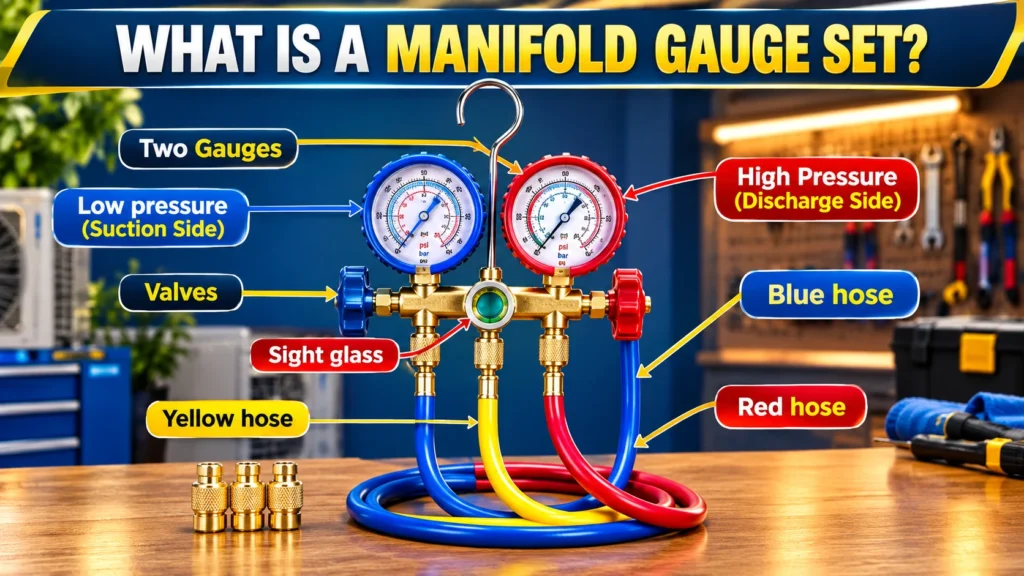
HVAC manifold gauge set do alag-alag pressure gauges, ek central valve manifold body, aur teen color-coded hoses (Blue, Yellow, Red) ka combination hota hai. Yeh system ke low-pressure aur high-pressure sides ko monitor karne, system ko vacuum karne, leak test karne, aur refrigerant charge karne ke kaam aata hai.
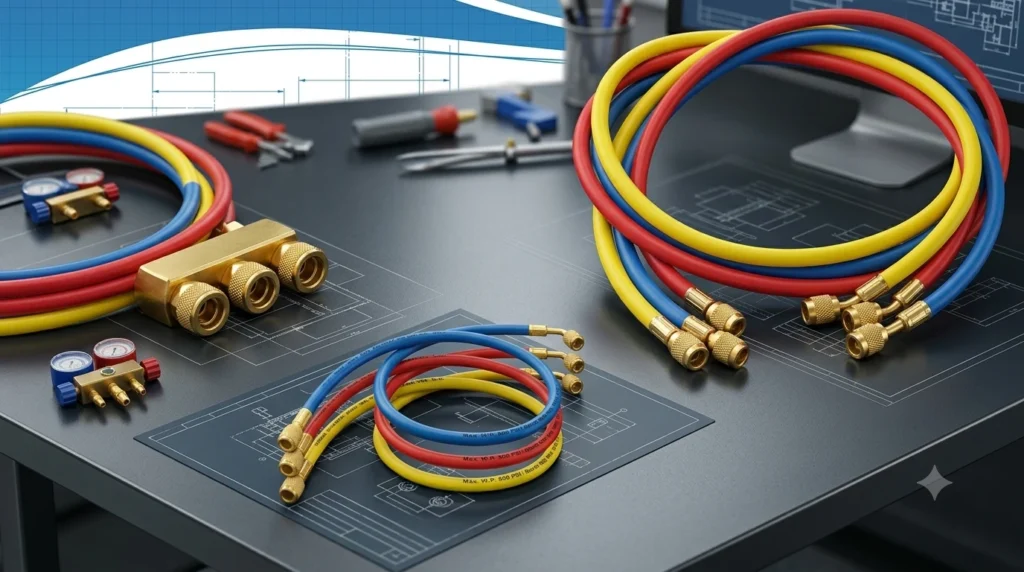
Hoses Color Coding:
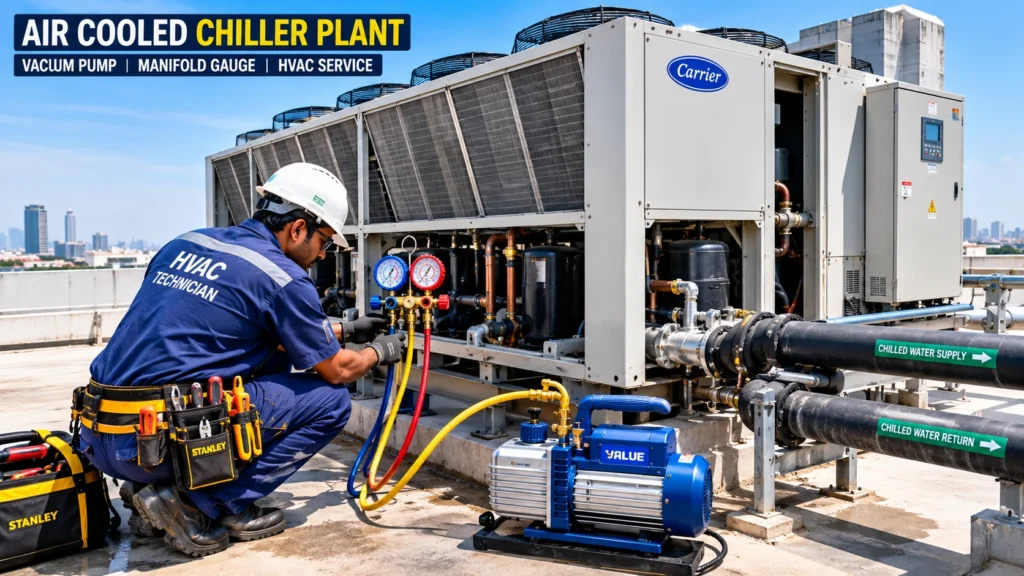
- Blue Hose (Low-Side): Suction line ya service port se connect hota hai.
- Red Hose (High-Side): Liquid line ya discharge side se connect hota hai.
- Yellow Hose (Center Utility): Vacuum pump, nitrogen cylinder, ya refrigerant cylinder se connect hota hai.
2. Low-Side Compound Gauge Kya Hai Aur Kaise Padhein?
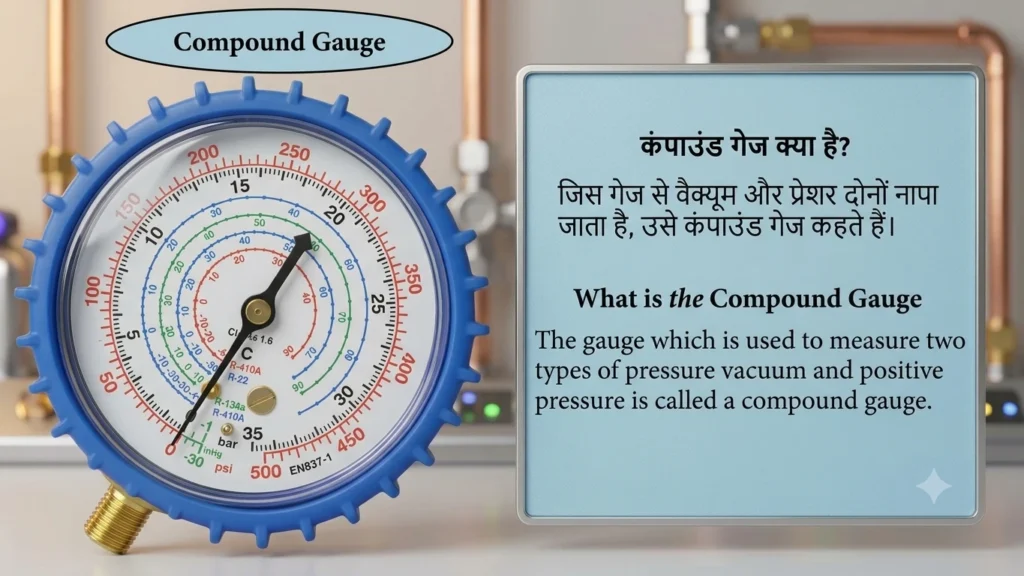
Compound gauge hamesha manifold manifold set ke baayein (left) taraf hota hai aur iska color Neela (Blue) hota hai.
Key Characteristics:
- Dual Scale Operation: Yeh atmospheric pressure se uper ka positive pressure (PSI / Bar) aur atmospheric pressure se neeche ka negative pressure (Vacuum in inHg) dono naap sakta hai.
- Connection Point: Yeh system ki low-pressure side yaani suction line se joda jata hai, jahan low-pressure vapor refrigerant behata hai.
Reading the Compound Gauge:
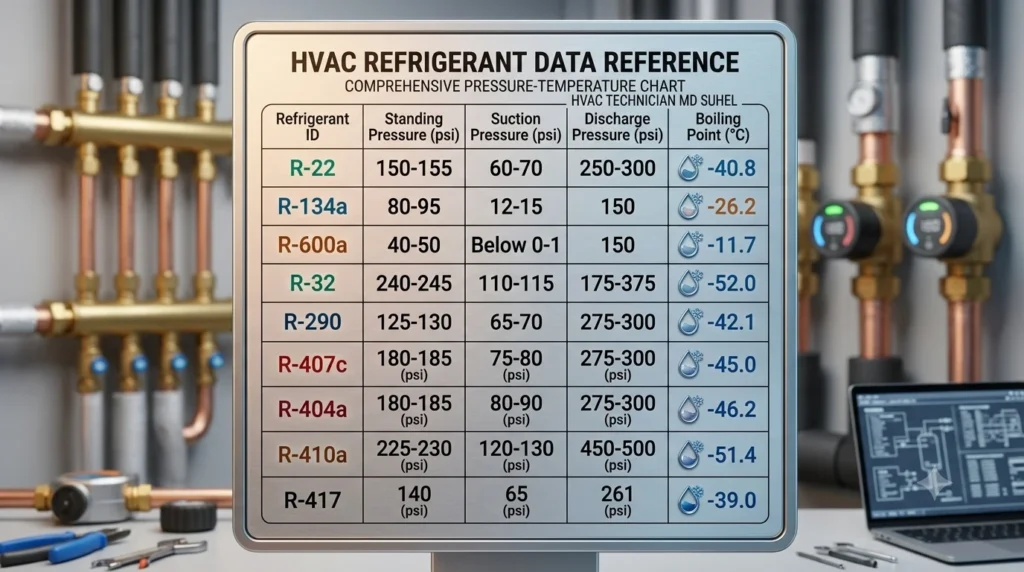
- Positive Pressure Scale (PSI/Bar): System chalne par ya standing pressure naapte waqt outer ya inner dial par PSI ki reading dekhein. Example: R-410A system mein suction pressure aamtaur par 115–130 PSI ke beech hota hai.
- Vacuum Scale (inHg): Jab system ko vacuum pump se evacuate kiya jata hai, toh needle zero (0) se neeche counter-clockwise ghumti hai aur 0 se 30\text{ inHg} (29.9\text{ inHg}) tak jaati hai.
- P-T Scale (Temperature Ring): Pressure scale ke andar alag-alag refrigerants (jaise R-410A, R-32, R-134a) ke rangiye temperature rings hote hain, jo us pressure par refrigerant ka saturation temperature batate hain.
3. High-Side Pressure Gauge Kya Hai Aur Kaise Padhein?
High-pressure gauge manifold set ke daayein (right) taraf hota hai aur iska color Laal (Red) hota hai.
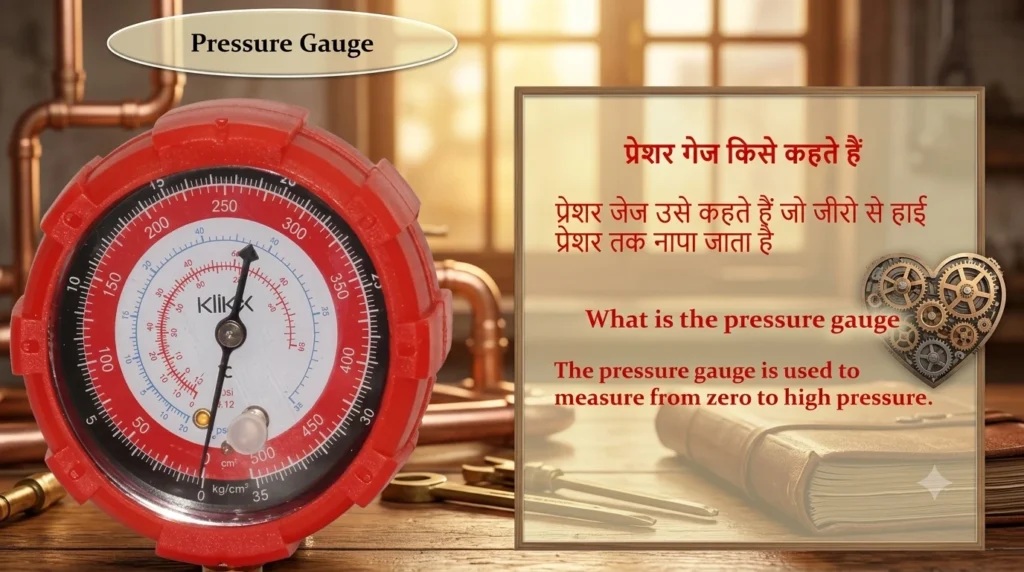
Key Characteristics:
- Only Positive Pressure Scale: Yeh sirf positive pressure ko measure karta hai (ispe vacuum scale nahi hota). Iski range aamtaur par se 500\text{ PSI} ya 800\text{ PSI} tak hoti hai.
- Connection Point: Yeh system ki high-pressure side yaani discharge line / liquid line se joda jata hai, jahan compressor se nikla high-pressure vapor ya liquid refrigerant hota hai.
Reading the High-Pressure Gauge:
- Discharge Pressure Reading: Compressor chalte waqt condenser side ka high pressure naapne ke liye iska upayog hota hai.
- Pressure Variation Example: R-410A system mein normal working condition ke dauran high-side pressure $320\text{ PSI}$ se $400\text{ PSI}$ ke beech ho sakta hai (ambient temperature ke hisaab se).
- Overpressure Awareness: Agar gauge ki reading abnormally high dikhai de, toh yeh dirty condenser coil, non-condensable gases, ya overcharging ka sanket hota hai.
4. Compound Gauge vs High Pressure Gauge (Comparison Table)
| Feature | Low-Side Compound Gauge (Blue) | High-Side Pressure Gauge (Red) |
| System Location | Suction Line (Evaporator side) | Discharge / Liquid Line (Condenser side) |
| Refrigerant State | Low-Pressure Vapor | High-Pressure Vapor / Liquid |
| Pressure Range | 30\text{ inHg} vacuum to 120\text{–}350\text{ PSI} | to 500\text{–}800\text{ PSI} |
| Vacuum Capability | Haan ( to 29.9\text{ inHg}) | Nahi |
| Primary Use | Suction pressure, vacuuming, low-side charging | Discharge pressure, high-side leak testing |
5. Manifold Gauge Padhte Waqt Zaroori Safety Precautions
- PPE Pehnein: Safe installation aur diagnostic testing ke dauran hamesha safety goggles aur insulated gloves pehnein taaki refrigerant burn se bacha ja sake.
- Purge Hoses: Service valves se hoses connect karne ke baad, air ko trap hone se bachane ke liye hoses ko halka sa purge zaroor karein.
- Calibrate Gauges: Manifold gauges ko regularly check karein. Agar atmospheric pressure par needle zero ($0$) par nahi rukti, toh gauge face plate par diye adjustment screw se recalibrate karein.
Conclusion
HVAC manifold gauge set ki sahi reading lena har technician ke liye basic aur sabse zaroori hunar hai. Low-side compound gauge aur high-side pressure gauge ke beech ka farq samajhkar aap system leaks, blockage, aur incorrect refrigerant charge ko aasaani se diagnose kar sakte hain.
Leave a Comment